


On the market, you’ll find plenty of smart watch models, but the most interesting ones are those that come with Google’s WearOS system, as it lets you install various third-party apps. This time, we’ll compare direct competitors: TicWatch Pro 5 vs Samsung Galaxy Watch6 vs Xiaomi Watch 2 Pro.
Technical specifications
| Model | TicWatch Pro 5 | Xiaomi Watch 2 Pro | Samsung Galaxy Watch6 |
|---|---|---|---|
| Official price at launch | 359.99 € | 349 € 44 mm Bluetooth version | 270 € Bluetooth version |
| Dimensions | 50.1 x 48 x 12.2 mm | 47.6 x 45.9 x 11.8 mm | 42.8 × 44.4 × 9.0 mm |
| Weight | 44.3 g | 54.5 g | 33.3 g |
| Material | 7000-series aluminum and nylon | stainless steel | aluminum |
| Protective glass | Corning Gorilla Glass | - | sapphire glass |
| Strap | silicone | silicone or leather | silicone or leather |
| Operating system | WearOS 3 | WearOS 3 | WearOS 4 |
| Processor | Snapdragon W5+ Gen 1 | Snapdragon W5+ Gen 1 | Exynos W930 |
| Memory | 2 GB RAM and 32 GB ROM | 2 GB RAM and 32 GB ROM | 2 GB RAM and 16 GB ROM |
| Display | 1.43" with 466 x 466 px resolution | 1.43" with 466 x 466 px resolution | 1.5" with 480 x 480 px resolution |
| brightness 1000 nits | brightness 600 nits | brightness 2000 nits | |
| AMOLED + Ultra-power-saving FSTN display | only AMOLED | only AMOLED | |
| Connectivity | Bluetooth 5.2 / Wi-Fi 2.4 Ghz | Bluetooth 5.2 / Wi-Fi 2.4 Ghz + 5 GHz | Bluetooth 5.3 / Wi-Fi 2.4 Ghz + 5 GHz |
| eSIM support | no | yes | yes |
| GNSS | GPS | Galileo | Glonass | Beidou | QZSS | dual-band L1+L5 GPS | Galileo | Glonass | Beidou | QZSS | GPS | Galileo | Glonass | Beidou |
| NFC | yes | yes | yes |
| Speaker | yes 1 W | yes | yes |
| Microphone | yes | yes | yes |
| Sensors | accelerometer; gyroscope; HD PPG heart rate sensor; SpO2 sensor; skin temperature sensor; off-body low-latency sensor; barometer; compass | optical heart rate sensor; accelerometer; gyroscope; ambient light sensor; barometer; bioelectrical impedance analysis sensor | accelerometer; barometer; bioelectrical impedance analysis sensor; electrical heart rate sensor; gyroscope; geomagnetic sensor; infrared thermal heart rate sensor; light sensor; optical heart rate sensor |
| Battery | 628 mAh | 495 mAh | 425 mAh |
| Water resistance | 5 ATM | 5 ATM | 5 ATM |
| App | Mobvoi Health | Mi Fitness | Galaxy Wearable |
We’ll show you where to buy the best TicWatch deals anywhere on the internet
These smartwatches are available at the best price from their official Mobvoi store, among all sellers. In our article, we explain how you can get the lowest price.
TicWatch Pro 5

TIP15-day delivery via Aliexpress Standard Shipping
For this product, Aliexpress Standard Shipping is available with guaranteed delivery within 15 days. It’s the most reliable delivery method and, in most cases, it’s handled by a courier company. The 15-day delivery is something we actually tested.
When you order from a Chinese warehouse, AliExpress adds a customs fee to your cart of about €3,70 per order. When you receive the package, you don’t pay anything extra.
TIP15-day delivery via Aliexpress Standard Shipping
For this product, Aliexpress Standard Shipping is available with guaranteed delivery within 15 days. It’s the most reliable delivery method and, in most cases, it’s handled by a courier company. The 15-day delivery is something we actually tested.
When you order from a Chinese warehouse, AliExpress adds a customs fee to your cart of about €3,70 per order. When you receive the package, you don’t pay anything extra.
Design and workmanship
Each of these models has a slightly different design, even though they’re basically very similar and there aren’t any unusual design features here. When it comes to build quality, the TicWatch Pro 5 and Samsung Galaxy Watch6 have an aluminum alloy frame, while the Xiaomi Watch 2 Pro comes with a steel frame.

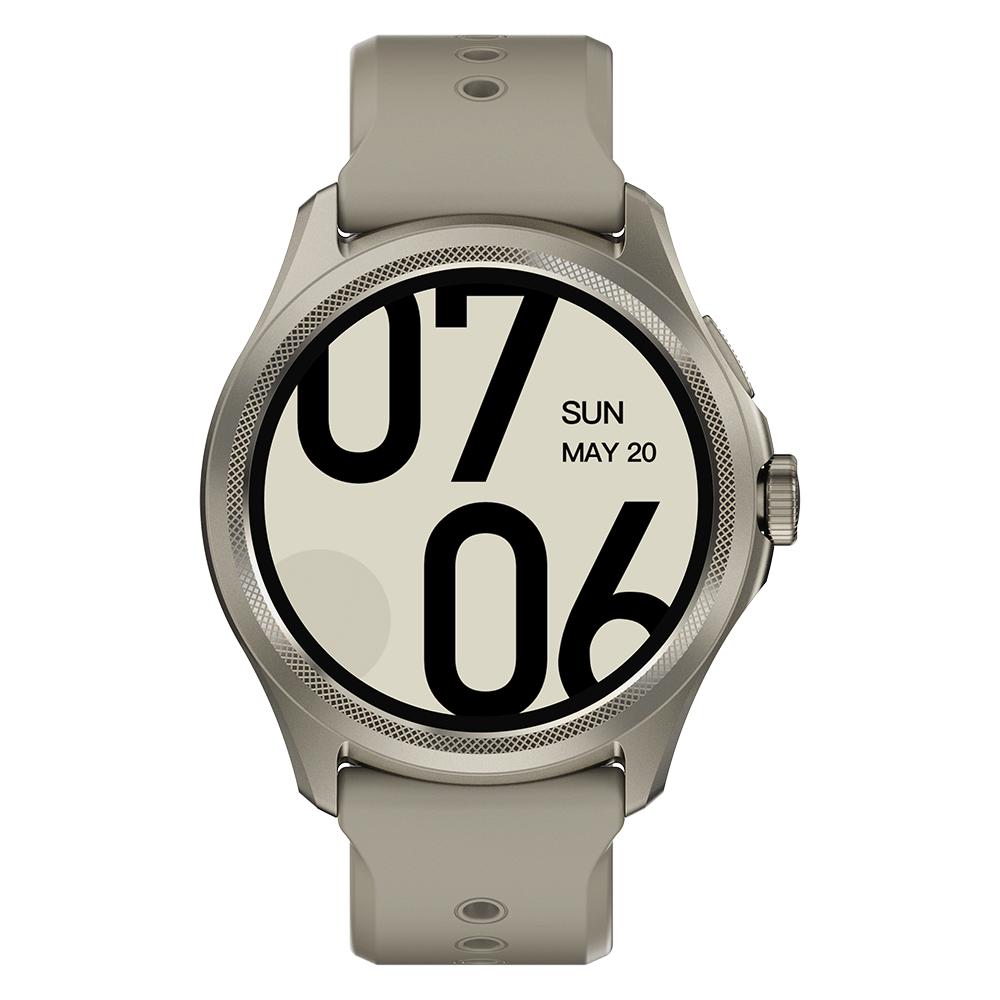
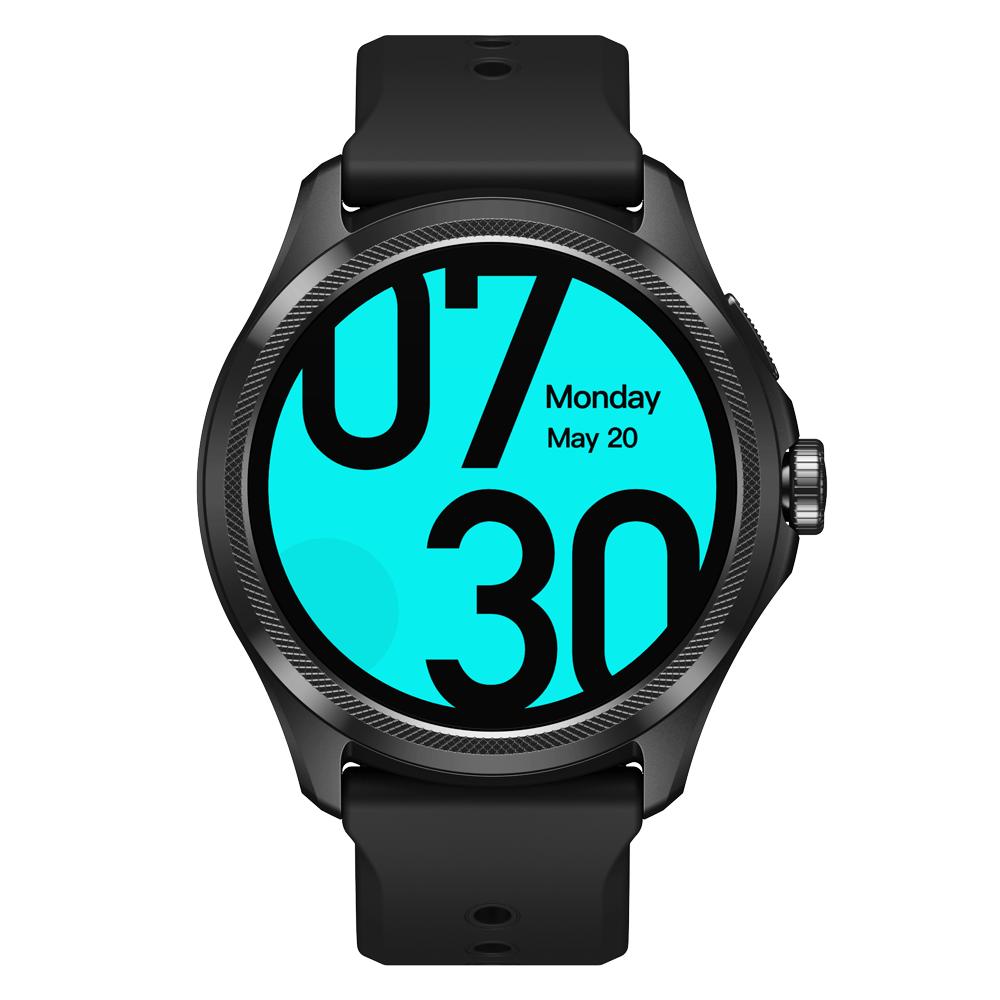
With Mobvoi—the brand that makes TicWatch—we can choose between two color options: black and sandy. In both color versions, the frame itself is that same color. It’s similar with Samsung, where you can get black and gray. Xiaomi also sticks to standard colors, so it offers black and brown; however, on the brown version the watch frame is glossy stainless steel, while the “brown” part is only the strap.

Samsung, however, offers several variants of its watches. You can buy the Galaxy Watch6 in either 44 mm or 40 mm, and the Classic version is also available with a rotating bezel in 47 and 43 mm variants.
While TicWatch only offers silicone straps in both color variants—similar to Samsung’s base version—Xiaomi has a silicone strap only on the black variant. In the brown color, the strap is made of leather. Samsung offers leather straps for the Classic version, while the base version is more sport-oriented.

The TicWatch Pro 5 has a 50 mm diameter, but it weighs just 44.3 g, even though the Xiaomi Watch 2 Pro—despite being smaller with a 46 mm size—is heavier. Its weight is 54.5 g. In this category, Samsung wins with its 33.3 g for the 44 mm version, while for comparison the 47 mm Classic version is already 59 g.
Design is quite subjective, but personally we like the Samsung watches the most. They have the biggest display, the thinnest frame, and a sapphire crystal.
TicWatch Pro 5 vs Samsung Galaxy Watch6 vs Xiaomi Watch 2 Pro 5: Display
All three compared smartwatch models feature an AMOLED display. Xiaomi and TicWatch match here with a 1.43″ diagonal. They also have the same resolution of 466 x 466 px and a pixel density of 326 PPI. Xiaomi Watch 2 Pro’s brightness is 600 nits, while TicWatch doesn’t specify this figure. Unofficial sources claim 1000 nits brightness.

The Samsung Galaxy Watch6, in all its versions, comes with a 1.5″ AMOLED display with a resolution of 480 x 480 px. The manufacturer doesn’t provide brightness either, but unofficial sources report 2000 nits—by far the highest among the compared models.
However, the most interesting feature in this category is TicWatch Pro 5’s secondary display, which is something of a brand bonus. Besides the standard AMOLED display, there’s also a second, power-saving display above it. It provides an alternative to an always-on display, during which the AMOLED display is inactive—saving battery.

On the other hand, this second display isn’t color, and it looks a bit like the display of classic digital watches, which may not appeal to everyone. Thanks to this secondary display, the TicWatch Pro 5 has a clear advantage over the others.
Xiaomi and Samsung also offer an LTE version
When buying the Xiaomi Watch 2 Pro and Samsung Galaxy Watch6, you can choose between the Bluetooth and LTE versions, while TicWatch currently doesn’t offer such an option. TicWatch Pro 5 is available only in the Bluetooth version.

On Samsung and Xiaomi smartwatches, you can add an eSIM. This lets you make calls using the watch even when you don’t have your smartphone nearby. Too bad our mobile operators don’t offer the option to copy your phone number to eSIM, so you have to load a different eSIM into the watch, which means a different phone number.
The TicWatch Pro 5 offers only standard calls via Bluetooth, but it’s not out of the question that the manufacturer will also introduce an LTE model, similar to the older version.

Samsung even has a very interesting feature if you use the watch with a Samsung phone. It can synchronize not only notifications, but also incoming calls to the watch from your smartphone—even when the smartphone isn’t nearby. Just make sure the watch is connected to the internet.
TicWatch Pro 5 vs Samsung Galaxy Watch6 vs Xiaomi Watch 2 Pro: Operating system
All three models use Google’s popular smartwatch operating system called WearOS. Xiaomi and TicWatch run on the older version 3.5, while the Samsung Galaxy Watch6 already comes with the latest version 4. Xiaomi and TicWatch don’t state how many WearOS system updates they should get. We don’t know the support length in this case. Unlike them, Samsung promises up to four updates.

Thanks to Google’s system, the watches offer the ability to install various third-party apps. In this respect, all models are almost the same. One of the few differences is that Google Assistant isn’t available on Mobvoi watches. The graphical interface also differs: Samsung and Xiaomi use a modern, fresh skin, while TicWatch’s is already a bit outdated.

However, the LTE version of the Xiaomi and Samsung watches has another small advantage, since the included dedicated eSIM also brings a separate internet data connection without needing a smartphone or a WiFi network.
Monitoring life functions and sports activity
Of course, there are functions for monitoring life functions and sports activity, including GPS to record your route while running or walking. All three watches measure heart rate, sleep duration and quality, as well as stress level or SpO2.

Unfortunately, we can’t compare the accuracy of these measurements because we don’t have them available for a direct comparison, but based on the specs we expect higher GPS accuracy during activity tracking on the Xiaomi Watch 2 Pro. That’s because it’s the first watch to support dual-band GNSS.

On the other hand, Samsung has another advantage again—but it depends on owning a Samsung smartphone. In that case, the watch can also measure blood pressure and an EKG, but it needs the Samsung Health Monitor app for that. The manufacturer recommends regular calibration using a blood pressure monitor.
TicWatch Pro 5 vs Samsung Galaxy Watch6 vs Xiaomi Watch 2 Pro: Battery and battery life
WearOS watches are packed with features and apps, which comes with a cost. They’re notoriously known for their short battery life on a single charge. If you know your way around WearOS smartwatches, you surely know that TicWatch is the battery-life king thanks to its power-saving display.

The TicWatch Pro 5 has up to a 628 mAh battery and a manufacturer-stated battery life of 80 hours. The Xiaomi Watch 2 Pro has a 495 mAh battery with a manufacturer-stated battery life of 65 hours, while the Samsung Galaxy Watch6 has the smallest, 425 mmAh battery and battery life of around 40 hours.

In real-world testing of the TicWatch Pro 5 smartwatches, even with intensive use we were still getting around 2 and a half days, while most owners of other WearOS watches have to charge their watches every day.
Hardware and price
The Xiaomi and TicWatch watches are powered by a Snapdragon W5+ Gen 1 processor. They also have the same RAM capacity—2 GB—and the same internal storage capacity—32 GB.
The Samsung Galaxy Watch6 is the exception, as its heart is the Exynos W930. It has 2 GB of RAM and 16 GB of internal storage. According to available reviews, the user experience with smooth performance is better on watches with a Snapdragon chipset.

You can buy the TicWatch Pro 5 for around €250 at the time the article is published on the manufacturer’s official website, while Xiaomi Watch 2 Pro is available for €269 in the LTE version and €240 in the Bluetooth version. You can get the Samsung Galaxy Watch6 starting from €229 in the 44 mm Bluetooth variant and €270 in the LTE variant. The Classic model line is only slightly more expensive.
TicWatch Pro 5 vs Samsung Galaxy Watch6 vs Xiaomi Watch 2 Pro: Overall verdict
Which of these three smartwatches is the best? It depends partly on your preferences. If you’re looking for modern watches with the latest system, a thin bezel around the display, you have a Samsung smartphone, and you also want to measure blood pressure, then the Samsung Galaxy Watch6 will most likely be the best choice.

Right behind them are the Xiaomi Watch 2 Pro, which also feature a modern and attractive design, a nice graphical interface, and dual-band GPS. They’re available, just like the Samsungs, in an LTE version, which lets you make calls even without having a smartphone nearby.
Last, but not the worst, are the TicWatch Pro 5, which—unlike the others—don’t offer an LTE version, but they have one big advantage over all the models. That’s the secondary display and significantly better battery life on a single charge.
Don’t miss the best coupons 📩
Subscribe and we’ll email you new coupons before they expire. We only send it once a month — no spam.


Discussion (0)