


Brand OnePlus introduced its new models a few days ago and reshuffled the lineup of the best smartphones.
🔥 Follow the latest from China Planet on Facebook and on Instagram.
We can’t help but share a comparison of the technical specs of two direct rivals: Xiaomi Mi 10 and the new OnePlus 8.
Both are a cheaper alternative to flagship phones
Although both smartphones fall into the flagship category, both manufacturers still offer upgraded models with the Pro branding.
Today, however, we’re focusing exactly on these two cheaper smartphones. We’ll take a closer look at their technical specifications and try to find out which one offers more.
Xiaomi Mi 10 vs OnePlus 8: Spec comparison

| Xiaomi Mi 10 | OnePlus 8 | |
|---|---|---|
| Dimensions | 162.6 x 74.8 x 9 mm | 160.2 x 72.9 x 8 mm |
| Weight | 208 g | 180 g |
| Material used | Glass/Aluminum | Glass/Aluminum |
| Display | AMOLED / 6.67 inches | AMOLED / 6.55 inches |
| Resolution | 1080 x 2340 px / 386 ppi | 1080 x 2400 px / 402 ppi |
| Refresh rate | 90 Hz | 90 Hz |
| Glass | Gorilla Glass 5 | Gorilla Glass |
| Other | HDR10+ | DCI-P3 | HDR10+ | DCI-P3 |
| Processor | Snapdragon 865 | Snapdragon 865 |
| Graphics | Adreno 650 | Adreno 650 |
| System memory | 8GB/12GB LPDDR5 | 8GB/12GB LPDDR4X |
| Storage | 128/256 UFS 3.0 | 128/256 UFS 3.0 |
| Memory cards | No | No |
| Operating system | Android 10 / MIUI 11 | Android 10 / OxygenOS 10 |
| Performance measured in AnTuTu | 579 000 | 574 000 |
| Primary camera | 108 MPx Samsung Bright S5KHMX | 48 MPx Sony IMX586 |
| aperture f/1.69 | sensor size 1/1.33” | 1.6 µm | aperture f/1.75 | sensor size 1/2.25” | 0.8 µm | |
| Laser/PDAF autofocus/optical stabilization | Laser/PDAF autofocus/optical stabilization | |
| 7 lenses | 6 lenses | |
| 8K 30 fps / 4K 60 fps video | 4K 30 fps / 60 fps video | |
| More cameras | 2 MPx portrait depth sensor | aperture f/2.4 | 1.4 µm | - |
| 2 MPx super macro | f/2.4 | 1.12 µm | 2 MPx macro | f/2.4 | 1.75 µm | |
| 13 MPx ultrawide | f/2.4 | 123° | 16 MPx ultrawide | f/2.2 | 116° | |
| Front camera | 20 MPx | 16 MP |
| Speakers | Stereo dual line 1216 | Stereo dual |
| Dual SIM | No | Yes |
| WiFi 6 | Yes | Yes |
| NFC | Yes | Yes |
| Bluetooth | 5.1 | 5.1 |
| Infra port | Yes | No |
| Location services | A-GPS / GPS: L1+L5 / Galileo: E1+E5a | GLONASS | Beidou | A-GPS / GPS: L1+L5 / Galileo: E1+E5a / GLONASS / Beidou |
| 3.5 mm jack | No | No |
| Battery | 4780 mAh | 4300 mAh |
| Fast charging | 30 W | 30 W |
| Wireless charging | 30 W | - |
| Reverse charging | 10 W | - |
Design
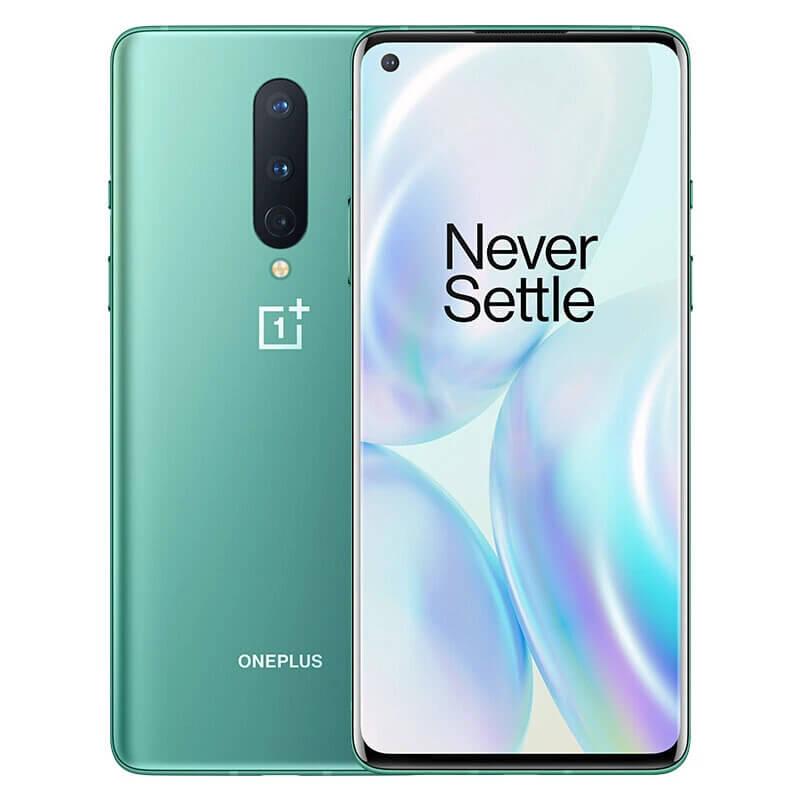
At first glance, it’s clear that these two smartphones aren’t cheap toys—they’re in the premium class. Mi 10 and OnePlus 8 look incredibly luxurious and are a real treat for the eyes.
That’s mainly thanks to their modern color shades, the curved edges of the back cover and display, but also to the neat arrangement of the rear cameras.


If we take a closer look, we’ll see they have a lot in common, and their design is very similar. Slightly smaller dimensions and up to 28 g less weight put the OnePlus 8 in the spotlight.
We also like the camera layout placed in the middle of the back cover. Even though appearance ratings are highly subjective and everyone likes something different, the technical specs don’t allow much debate. In this category, we lean toward OnePlus 8.
Display
We can’t fault the display on any of the compared smartphones. Both are premium AMOLED panels with high pixel density and curved edges. Both also still offer a top-tier refresh rate of 90 Hz.

Even the display punch hole – the opening for the front camera – has the same position and fairly decent, non-intrusive dimensions. Even though we don’t know the exact display parameters of the OnePlus, there definitely won’t be huge differences.
OnePlus is slightly disadvantaged because its display is smaller. However, its diagonal is only 0.12 inches shorter, which is just 3 mm in conversion—an almost negligible number.
Both displays are protected by the standard Gorilla Glass.

There isn’t much to compare in this category, so we can say that both displays are more or less evenly matched opponents.
Power
If you look at the detailed performance hardware specs, you’ll notice just one difference. Mi 10 comes with the newer and faster LPDDR5 module, while OnePlus uses LPDDR4x.
That said, it doesn’t play a big role, and both smartphones deliver highly above-average performance. None of them will disappoint, and we’re comfortable saying that for many of us, these are “rockets” that are even hardware-overkill.

With almost the same hardware, though, a lot can come down to the software package. Both phones run on Android 10, but each uses its own custom software overlay.
Performance can also be influenced significantly by software optimization and update frequency. However, we know that both brands have very positive reviews in this area, so in this category we declare a draw.
Cameras
Photos and cameras on mobile phones have always been among the most closely watched and deciding factors. That’s still true today, and manufacturers keep outdoing each other—not only in megapixels, but thankfully also in the quality of the output files.


A 108 MP sensor with seven lenses, four rear sensors in total, 8K video, and a 20 MP front camera put Xiaomi Mi 10 at the top. Even the ultra-wide sensor on the Mi 10 has slightly better specs.

Sometimes, though, it’s possible to achieve better results even with a spec sheet that looks weaker. But we can only judge that when comparing real photos. Today, however, we’re comparing technical specifications, and in terms of camera equipment, Xiaomi Mi 10 clearly comes out ahead.
Additional equipment
There isn’t much to compare in this category either. Both Xiaomi Mi 10 and OnePlus 8 got the best. Dual SIM support from that pair is only available on OnePlus 8; the European version of Mi 10 didn’t get this feature. However, both models support 5G mobile networks.
Both come with wireless technologies WiFi 6 and Bluetooth 5.1, and both also support dual GPS. Both have stereo speakers, and neither Mi 10 nor OnePlus 8 includes a 3.5 mm audio connector—that’s a shame.

On top of that, Xiaomi Mi 10 has an IR port, but for many users it doesn’t play a significant role. So we declare a draw in this category as well.
Battery and charging
In the final lines of our table, you could also see the parameters related to the battery and charging of both smartphones. So you can already judge for yourself that the Xiaomi Mi 10 is clearly better in this area.

It’s not only because of the higher battery capacity. It’s also thanks to convenient and fast wireless charging, or the option to charge other devices using so-called reverse charging. The OnePlus 8 is noticeably behind in this category.
Prices
As always, we’ll mention that the price always significantly influences many users’ smartphone choice. After all, it reflects what financial options they have—so what device they end up buying. Will it be the same now? Will the price decide?

We have to admit that both of the compared smartphones arrived on the European market with high prices, and the difference between the Xiaomi Mi 10 and the OnePlus 8 was huge—in favor of neither, especially not the “ten” line.
Just for interest, we’ll note that the Mi 10 with 8 GB RAM + 128 GB storage was listed at €799, and the same memory version of OnePlus 8 was €699.
However, both smartphones are already available with discount coupons, so when comparing, we’ll take into account the prices you can get them for right now.
Xiaomi Mi 10 with 8 GB RAM and 128 GB storage can currently be bought for about 625 euros. OnePlus 8 with 8 GB RAM and 128 GB storage is already available for about 620 euros.
OnePlus 8, global ROM
 CZ warehouse
TIPExpress delivery from the Czech warehouse with no customs duties and VAT.
This product will be delivered to you express from a local Czech warehouse. Delivery from the Czech Republic usually takes 7–10 days and is handled by courier. When it arrives, you don’t pay any extra fees—no customs, no VAT.
As you can see, the price difference isn’t that significant anymore, and that’s why in the final assessment we can focus only on the parameters.
Final verdict
Making a decision isn’t easy, because both smartphones have very similar specs and almost the same premium look. Ideally, you’d want the Xiaomi Mi 10 with the dimensions and weight of the OnePlus 8, even with its lower price. But that’s not possible, and we have to choose one of them.
Our decision points to the Xiaomi Mi 10. It’s because of the better camera setup, the battery parameters, and the MIUI layer that suits us better. The price difference doesn’t wipe out these advantages by a long shot—which is exactly why the Mi 10 is our favorite.

However, we also have to add that we’re big fans of the OnePlus brand, and their model with the number 8 is definitely not a waste. If the price difference were as huge as it was when both smartphones were launched, we might have leaned toward it instead.
Don’t miss the best coupons 📩
Subscribe and we’ll email you new coupons before they expire. We only send it once a month — no spam.


Discussion (0)